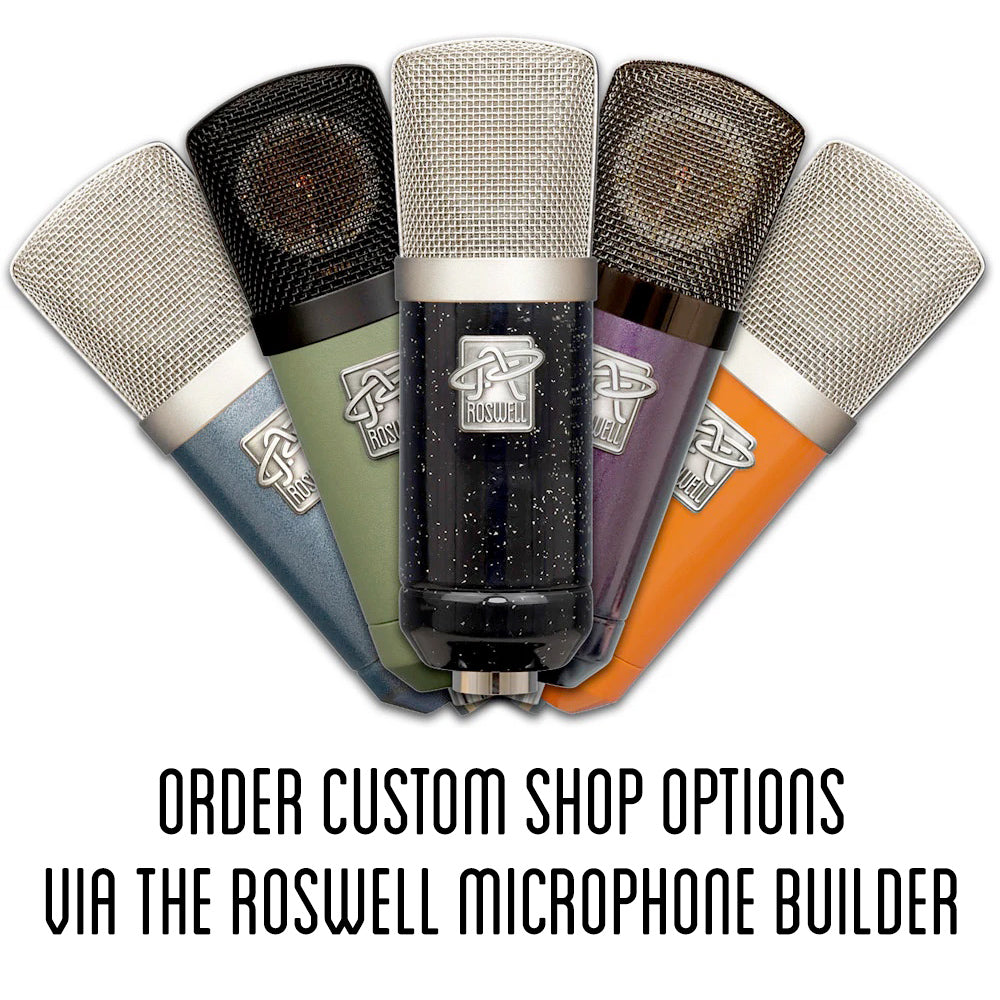
"The Roswell Cab Mic has become one of my go-to mics for electric guitar." - David Grissom
The Cab Mic is a single-mic guitar cab recording solution, designed for the studio, but rugged enough for the stage. It is on tour with Deep Purple, Little Feat, Foghat, Animals as Leaders, and Joe Jackson. Scroll down for artist testimonials.
Cab Mic Demo & Review Videos
Overview
Voiced like a ribbon mic, with the punch of a dynamic and the detail of a condenser
Simple, repeatable, single-mic capture: center the mic on the dust cap
Never harsh, never too bright
It isn't merely a new microphone. It is a new way to record guitar: easier, faster to set up, faster to mix (little to no EQ required). Your tracks will sound like the amp in the room.
Origin Story
David Grissom and Tim Pierce had been testing the RM8 mic on cab. Both loved the tone. Neither needed the RM8's internal pattern circuitry. I commented to David that I could design a simpler, purpose-built mic for guitar cab, to recreate the tone he loved in the RM8, but make it easier to use and more accessible for guitarists. He liked the idea. (That's why I put his initials on the circuit board.)
Guitar cabs represent a fairly unique application. They can be loud, so the mic would need huge amounts of headroom. The mic should have a soft top end, to eliminate harshness. The mic should work well on its own, so that artists need not manage comb filtering (phase cancellations) invariably created when two or more mics are put on the speaker.
We designed a low-distortion circuit and a large-diaphragm capsule with a unique tuning. We implemented the circuit with fantastic components. The combination has beaten numerous popular mics on guitar cab, including dynamics, condensers, and ribbons.
The Cab Mic ships with a heavy duty swivel mount and a mic sock.
In our testing, shockmounts do not seem necessary for recording guitar cab; the cab is louder than (and causing more vibration than) foot or vehicle traffic, or whatever other ambient vibrations you would normally want to isolate.
Most guitarists will tell you to never aim a microphone at the center of the dust cap. It's true that that position is too bright and too harsh for common dynamic mics. But as Steve Albini pointed out many years ago, the center of the speaker is the location with the least smearing, the least filtering, the least distortion, the most clarity, and the most articulation. That's where he usually miked a cab. It's impossible to argue with his results (e.g. Nirvana).
The trick is to use a microphone that works well in that location. Albini seemed to prefer vintage RCA ribbon mics. Those sound great if you have a $4000 budget. The Roswell Cab mic works beautifully in the same position, at a slightly lower cost.
Start with the mic's grille centered on the dust cap of the speaker. Stand the mic with six inches of space between the mic grille and the speaker cloth. Crank up the amp's master volume to whatever that amp's sweet spot is; the mic can take whatever level you give it, and it won't overload the preamp.
To increase bass content, move the mic closer. To decrease bass content, move the mic back. The Cab Mic has good proximity effect -- more linear and more predictable than a ribbon mic (read that as "less likely to get muddy").
Unique voicing makes it easy to capture the tone of your amp.
The mic's gain staging accommodates 100W tube amps, without clipping your preamp or converters.
Solid, high-quality construction ensures real-world durability and long service life.
Comparing the Cab Mic to Mini K microphones
All four of the "Mini K" mics (Mini K47, Mini K47x, Mini K67x, Mini K87) can be used on guitar cabs. They can work beautifully in that application. The band Little Feat used the Mini K67x on two cabs on stage for several years, then changed to the Cab Mic.
The Cab Mic has lower sensitivity, lower output, and more headroom than all of those models; therefore if your cab is loud, the Cab Mic will usually perform better than the Mini K models.
In terms of the mic's internals, the Cab Mic uses a different capsule from the rest of the mics. The Cab Mic's circuit has a similar topology to the KD, because the main applications of these two models (guitar cab and kick drum) require very high SPL capability. The Cab Mic circuit is unique in its frequency response and distortion characteristics, and employs some very nice vintage European film capacitors not found in other models. Like every other Roswell microphone, the Cab Mic is specifically voiced, tuned, and optimized to delivery extremely high performance for its intended application.
Comparing the Cab Mic to Ribbon mics
As noted previously, the Cab Mic's voicing is similar to ribbon mics, primarily in its frequency response above 1kHz. The Cab Mic's response rolls off gently above 3kHz, which prevents guitar cabs from sounding harsh.
The Cab Mic has a nominally Cardioid polar pattern, which gives it more-linear and more predictable proximity effect than any Figure-8 ribbon. (For the purists: the Cab Mic's polar pattern is slightly narrower than textbook Cardioid; this helps give the mic its punchy, articulate sound.)
The Cab Mic is not fragile in the way that ribbon mics are. A puff of air on the capsule will not break the Cab Mic.
Using the Cab Mic on other sources
The Cab Mic's primary application is to record amplified guitar cabinets. It will work beautifully on trumpet and other brass instruments, and on many percussion sources. It will work well as a drum room mic; its soft top end naturally attenuates cymbal wash, which is a desirable characteristic for drum room tracks that would be heavily compressed.
This model is not intended for use on vocals, acoustic guitars, acoustic bass, or piano. Every other Roswell microphone will deliver superior results on those sources. This model's internal gain staging is optimized for high SPL sources, e.g. guitar cab, brass, drum room.
Cab Mic FAQ
Q: Does the Cab Mic require phantom power?
Yes. The Cab Mic is a large-diaphragm condenser microphone. It requires +48V phantom power.
Q: Is the Cab Mic compatible with Neural DSP hardware?
The Quad Cortex and Quad Cortex Mini both supply phantom power, and should be compatible with the Cab Mic.
The Nano Cortex does not contain a phantom power supply; using the Cab Mic with the Nano Cortex therefore requires the use of an external phantom power supply (find options on Amazon).
Q: How should the Cab Mic be positioned?
The mic includes a printed "quick start" guide that illustrates the recommended starting position: center the mic's capsule on the dust cap of the speaker. Position the mic six inches (15cm) from the grille cloth. Move the mic closer if you need more bass (unlikely) or back it off farther to reduce bass.
That position is a starting point, not a requirement. The key takeaway here is that the Cab Mic is not an SM57 and need not be (a) shoved against the grille cloth, nor (b) positioned "off cone", nor (c) angled to put the speaker off-axis.
The Cab Mic has much better bass response than most common dynamic mics; therefore it need not be and usually should not be pressed into the grille cloth. It will sound more natural if positioned as we recommend -- but of course, your ears and preferences are the final guide to mic position.
Q: Can the Cab Mic be used on loud, 100W tube amps?
Yes. We designed the mic's internal gain staging to withstand 100W amps without clipping the mic's internal circuitry and without clipping the mic preamp or audio interface.
The Cab Mic has approximately 6dB higher sensitivity than an SM57. For most preamps, start with the input gain set to the minimum level.
For preamps that insist on adding 10-20dB of gain even when the input gain control is minimized (e.g. the 1073), engage the preamp's attenuation pad.
Q: Can the Cab Mic be used with a second or third mic on the same guitar cab?
It can, of course, but it was designed to make the use of multiple mics unnecessary. Although several influential producers have promoted multi-mic combinations for guitar cab, the high cost of that approach might not be obvious: not merely the cost of multiple mics/stands/preamps channels, but more importantly the time cost of carefully positioning both mics to avoid phase problems (comb filtering), and the time cost of EQ'ing and mixing those tracks to form one cohesive sound. The entire point of the Cab Mic is to capture a great sound with one single microphone.
We recommend auditioning the Cab Mic on its own, positioned as we recommend, before deciding whether it is necessary to add more microphones to capture a sound that works for your production.
Most Cab Mic buyers report getting the best-sounding tracks they've ever captured, using one Cab Mic on its own. They also report significant time savings: no need to set up multiple mics, set input gain for multiple channels, position multiple mics for best sound and no comb filtering, EQ multiple tracks independently, mix multiple tracks to create one cohesive sound.
Q: Is it difficult to position the Cab Mic?
No. The Cab Mic was designed to be very easy to position: literally center it on the speaker, six inches back. There is no need to mark the cab's off-cone "sweet spot" with tape. There is no need for a remote-controlled robot positioning arm. There is no need to iteratively audition the mic while making quarter-inch placement changes to find the best sound.
The Cab Mic has much fuller frequency response than any of the common dynamic mics used for this application, and it is much less fussy about position.
Tech Data
Model:
Cab Mic
Acoustic Principle:
Pressure gradient transducer
Polar Pattern:
Cardioid
Capsule:
34mm O.D. True Condenser
Sensitivity:
4 mV/Pa
Impedance:
112 Ohms
Signal-to-noise:
83 dBA
Equivalent noise:
11 dBA
Supply voltage:
48±4 VDC
Output:
Electronically balanced
Physical dimensions:
150 × 44mm; 380g (mic only)
Couldn't load pickup availability
Cab Mic - Guitar Microphone
1 / of6
Tyler and Jared of the No Cover Charge Podcast brought two Cab Mics to the Marshall Museum to record Randy Rhoads' half-stack, possibly the loudest Marshall rig on the planet!
David Grissom's signature series PRS tube amp sounds fantastic with the Roswell Cab Mic.
Glenn Fricker loves the Cab Mic: "This mic would have saved me years of grief!"
Roswell Cab Mic (in "(Walk Like An) Egyptian Blue" finish) on an Orange Tour Baby with massively heavy 2x12 cab.
"Is the Cab Mic going to become a permanent part of my toolkit for guitar tone? OMG yes. This thing is awesome. It does a fantastic job of capturing the natural vibe and mojo of the amp, without getting harsh. It blends into tracks incredibly well without any processing."
"One of the things I like about the Roswell Cab Mic is that it accurately reproduces my dynamic range and the dynamic range of the amplifier. When I pick soft, it’s clean. And when I pick harder, the gain on the amp is triggered. This mic reveals and transmits that perfectly.
"The Roswell Cab Mic sounds clear, open, and uncompressed. It sounds musical with any amount of gain, distortion, or overdrive. To me, it sounds like you’re standing in front of the amp and listening with your ears."
"The Roswell Cab Mic has become one of my go-to mics for electric guitar. The smooth top end and robust lows make the mic easy to dial in. I can place the mic in the center of the cone without any harshness. I never feel the need to add another mic to balance missing frequencies; just move this mic around the cone a bit to get the tone I want without any phase issues from a second mic. Highly recommended!"
"At a fraction of the cost of a good ribbon mic, let alone a condenser, ribbon, and dynamic mic combo, the Cab Mic is a great deal. But regardless of price, it’s also my new favorite for recording guitar amps. How we record amps hasn’t altered much since the 1960s, but I think that’s about to change."
"[The Cab Mic] sounds really awesome! The tone is warm, punchy and not harsh at all, which is amazing. And I love that the positioning was really easy. You guys did incredible work on this mic!"
"Just finished up a 4 day session with Charlie Hunter playing and producing. Used the Cab mic on his guitar and it is a thing of voodoo!! The guitar is so smooth."
"The Roswell Cab Mic is so killer I probably should have brought a change of pants to the studio. In fact, after the first day of recording guitars with it, I told all my other mics to go straight to hell. Did I hurt their feelings? Probably. But it’s like I don’t even care."
"If you love your amp sound and have tried everything under the sun to capture it? Look No Further!! The Cab Mic from Roswell is the answer. It reproduces the exact sound every time. PS: If you don't like your sound, proceed with caution."
"While it sounds great on loud, crunchy amps, I was most impressed with what it did for bluesy and jazzy clean tones. On the Princeton with the built-in tremolo engaged, it captured the thick, pulsing notes in a wonderfully intimate way... It is easy to set up, delivers great sounds across a range of amps, and sits well in a mix. I expect it will see regular use in my future electric guitar recordings."
"This mic really is great. It's so flattering. This has the best of both worlds -- the detail, and the midrange, and the clarity of a condenser, with this beautiful and clean low end, big and muscular. I think this mic is totally badass."
"The Cab Mic captures the sound of the amp as I hear it in the room with an accuracy few other mics can match. It offers full low end, natural mid range, and smoothly rolled off highs, with shockingly crisp transients, all of which flatter tones from clean to distorted."
Yes, these days everyone says you need to mic electric guitar cabinets with a ribbon mic, dynamic mic, or maybe even both. Sure. Sometimes. For 29 years, I have also used a Langevin CR-3A condenser mic, manufactured by Manley many decades ago. It turned out my late pal, Steve Albini, also loved using this mic on guitar cabinets. Hmmm. When my magazine, Tape Op, ran a review of Roswell Pro Audio’s Cab Mic, a condenser especially designed for electric guitar, I was intrigued. When I got my own, I was overjoyed. Here’s the detail and excitement of electric guitar, via a mic that doesn’t need 30 dB of pads and is voiced for this purpose. Smart!
"I can see why this mic is such a big hit. I plugged it and did nothing to it, recording a very short thing…. played it through my speakers, and lo and behold… it sounds EXACTLY LIKE WHAT IS COMING OUT MY AMP IN THE ROOM! HOLY ****!"
The Delphos II works beautifully on guitar cab, and with its pad engaged can accommodate very loud (100W) amps. It has a flat frequency response, which is subjectively brighter than the Cab Mic (because the Cab Mic rolls off frequencies above 4kHz). The Delphos II is significantly more versatile, due to its neutral voicing, 3 polar patterns, and higher sensitivity. On guitar cab, it sounds very much like the vintage Sony C800.
The Mini K87 is a favorite on both clean and high gain guitar tones. However, it might run out of headroom on very loud rigs (50-100W rigs with the master volume cranked). To capture very loud guitars, we recommend the Cab Mic, which uses a clean/low-distortion circuit like the Mini K87, with a dark rather than neutral top end. The Cab Mic is usually easier to position, and accommodates high SPL without clipping the mic, preamp, or converters.
The Mini K87 is arguably the best deal on the market for VO, vocals, acoustic guitar; it's unbeatable as an all-purpose studio mic. The Cab Mic is a specialty product that won't do 100 things well -- but the one thing it does, it does better than anything else at 3x the price.
The Mini K47 and the Cab Mic share the same shell, but the internals are significantly different, and the intended applications are different. The Cab Mic is great on guitar cabs and brass. The Mini K47 can work on those sources if care is taken with gain staging, but its sweet spot is everything else in the studio: acoustic strings, vocals, drum overheads, piano, percussion, etc.
To be more specific: the Mini K47 has enough headroom for most 50W amps. Its output level is relatively high, and therefore the preamp might overload on loud configurations. The Cab Mic has much much much more headroom, and will not overload your preamp even on a 100W amp at "earplugs required" volumes.
A frequency response comparison would show the Mini K47 and Cab Mic to be similar below 1kHz. Around 3kHz, the Cab Mic's response rolls off; the -3dB point is @ 7kHz. The Mini K47 response rises through these frequencies, because on sources other than guitar cab, 4-6kHz is a critical frequency band for articulation and presence. In simpler terms, the Mini K47 is much brighter than the Cab Mic.
Ultimately, if you want a mic for many sources, the Mini K47 is the way to go. If you are looking for a simpler way to get great guitar tones faster, and you have the budget for a dedicated, special purpose microphone, the Cab Mic is a great solution.
Customer Reviews
Overall rating: 5.0 / 5 from 47 reviews.
I have been reading about all the hype over this mic, plus watching all the vids I could. I am very particular about tone and this mic has it in spades. Right off the bat, setting it up at 6” center cone like recommended, it needs next to no eq. Obviously, a good amp helps. I have used many mics over the years. Expensive, cheap, and this is honestly a forever mic. Also, it’s a great price point for home studios! I also have a mini 47 as my vocal mic and it is fantastic. Roswell is doing things right and I will be a loyal client for years to come. Thanks guys! Bob
It’s rare for advertisers to not embellish reviews regarding their products, but everything I read was absolutely true in the studio. This cab mic really is something special. The sound you hear in the room is pretty much exact to what you hear on your recording. It’s an amazing piece of gear.
Thank you and your team for developing such a great product!
I've been on a mic search, for the past couple of months, to pair with my Mesa Boogie Mark V 90 watt and EVH el34 100 watt amps. I've been using the Shure 57 and the Royer 121, and thought that was as good as it was going to get. I WAS COMPLETELY WRONG!!!
Dude and dudettes...
Roswell Audio has presented us with possibly the best mic ever to mic your existing guitar cab. The Roswell mic cab. You're not going to find any video clips(yet) of how it handles some extreme metal tones. But, I can you tell you 1st hand that it delivers 100x better than the previously mentioned mics. Stop teasing yourself and buy the mic. You won't be disappointed. It chugs!!!!
I bought it solely on Tim Pierce’s and David Grissom’s word.
The price was a no brainer. We all spend tons of money on our guitar rigs only to have the ‘chain of custody’ broken with a hurried or thoughtless production company.
I want the people ‘in the seats’ to appreciate what we’ve all worked and paid dearly for.
Thank you Roswell for the Cab Mic. It now resides in the back of my Deluxe! Ready to earn its keep.
Dennis ‘Crash’ Craven
Wichita KS
Well I am live audio engineer been mixing live bands for 48 years. I purchased 2 of your cab microphones to use on guitar cabs for live shows. I recently used 1 of them on vintage tweed amp with 1 single 12 each speaker. I was blown away with how good it sounded, it was so accurate to what I heard standing in front of his amp. So very happy
I bought your cab microphones. Looking forward to using them on other guitar amps and shows I have coming up.
My name is Kevin Hollister and I work for a Caesar’s casino in Windsor Ontario Canada. Such a perfect mic you have built.
Thank you
Kevin Hollister,
This microphone gives exactly what it says it will do. I record my guitar and playback through monitors and it sounds exactly as in the room sound with no eqing. And no fizz on higher gain tones. Awesome.
Very cool mic! It's kind of its own thing. It feels like it sits between an SM57 and a Royer 121. I have actually put away my SM57 and have shaped my productions around this mic on my amps. Beautiful warm tone, without getting boomy or loose. It also is very forgiving of mic placement, and has shown to complement in many different positions on my fender amps. Definitely one that everyone should have in their arsenal!
Great Mic! Very impressed with how well balanced this mic is - minimal placement time and I got to exactly how I wanted my guitars to sound. Highly recommend
This mic has made it so easy to get great recorded amp tones!! Dial your amp, stick the mic in front of it, and press record!! The engineers at the studios I work in are loving it! Works pretty well in a live setting, too.
The quality speaks for itself in the craftsmanship and care that goes into Roswell Audio microphones, and the Cab Mic is no different.
From the physical essence of the Soylent Green enclosure, to the audio clarity of "it sounds like you're in front of the amp," it makes this a no-brainer choice to have in any mic locker.
I'm excited to continue putting it through it's paces, as well as seeing how it fares on other studio needs beyond just guitar cabinets, and I expect to find it holds up well to a lot of use-case scenarios.
The Roswell cab mic blew me away. It captures my dynamic range with precision. What goes in is exactly what comes out, no smear. I love how it handles the breakup tone but it’s just as articulate on the quieter stuff. The bonus? It frees up a ribbon mic to use on other things.
Tight & Musical 😎
Love at first listen (in my studio). I’ll spare the reader more platitudes and will describe what I heard.
Initial Setup: Strat > Granger M50 (Plexi) on 3.5/4 > 4x12 (2 FJ GBs & 2 Scumback H55s) > Cab Mic 6” & 12” off the grille, dead center to relative speaker > ISA2 pre > converter.
Second Setup (amp swap): Tweed Deluxe with a FJ C1270, everything else the same
1. The presence of the mic extends down well into the lower frequency spectrum. Even at 12” I got clear attack definition on my lower strings, which is often where mics are either too muddy or too thin. This is a MAJOR differentiator in my mic locker.
2. It captures distance very well without sounding obviously better at certain distances.
3. Sonically, it’s like the love child of a 67, a BD M160, and a BD M201. Its presence never gets ice picky (you Fender players know what I’m talking about). To my ear, it responds like a dynamic mic but with more accuracy.
4. It’s a “modern” sounding mic - it doesn’t color at all, so it plays nice with other mics if you like to blend.
5. A Plexi on 4 is pretty loud (lol), but it took the SPL great and wasn’t better or worse at higher or lower volumes.
To sum up: if a guitarist is mic’d with this and sounds bad, it’s the guitarist. Promise. I love this thing and you will too.
The Cab Mic is fantastic!
It simplifies the process of recording guitar amps SO much and it sounds great.
It turns what has traditionally been a rather meticulous process with variable results into pretty much a "point and shoot" thing.
I give it my highest recommendation with absolutely no reservations.
It really does sound like a condenser, dynamic and ribbon all rolled into one. Because the placement is a no brainer, repeatable recordings are no longer hit and miss. It seems to work the same no matter what amp cab is used. And very little EQ is needed assuming the amp sounds good to begin with. Matt, as soon as I get back from a trip, I am ordering another one for another amp in the studio. Thanks, guys, for an excellent product. PeterM
The Cab Mic really does what it says it will, honestly the best sounding recordings of my main amp setup I have ever gotten. I'd even go so far as to say that it not only sounds like the amp in the room, but if you get it set just right, it sounds better than the amp in the room.
Looking forward to basically using this on all the electric guitars on my next album, and who knows what else, excited to try it out on other sources as well.
Great job Matt/Roswell, knocked it out of the park!
I bought a Roswell Cab Mic. My biggest complaint about mic'd guitars is the mic'd sound never sounding the same as the amp in the room. Now it does! This is the best guitar mic I've ever heard. The tone is so balanced. Tight Bottom, sweet mids and a round top end. It is simply amazing.
I heard about this mic from a few other studio players here in Nashville. Now I know what they were raving about.
Thank you Roswell Pro Audio
I have a pretty elaborate guitar rig comprised of a bunch of vintage Marshall heads and cabs with various versions of old Celestions. I’m also a recording engineer and focus on big guitar projects. When recording my own rig, I have struggled for years to capture the sound that I hear when I stand in front of it. I’ve tried multiple mics, single mics and have tried a bunch of different brands and types of microphones over the years. I’ve always had GREAT guitar sounds BUT, not the sound I hear in the room. It is always colored in some fashion. Usually too dark and one dimensional. I find myself changing my amp settings to try and compensate for what the mic isn’t giving me. Not ideal.
Then I hear about the Roswell cab mic on the No Cover Charge podcast. I expected it to cost a fortune, but went to the website to research it. I was blown away at the affordability and ordered one up. (tons of great color options)
I received it and headed to the studio. Set it up as recommended, dead center of the speaker and six inches from the grille. I played and dialed my amp to how I like to hear it in the room. Moment of truth- I recorded a single track on a project I’m working on and listened back. There it is. There’s the sound I hear in the room. I had to listen about 100 times before I actually believed it was real LOL!
This mic is a true game changer for me. I couldn’t be happier with the mic. Built like a tank, sounds great and the customer service is out of this world. I have received more than one email from Matt, the owner, checking in to make sure I’m happy. That’s pretty much unheard of. Well done, Roswell. I’ll definitely be back for more.
This is a great mic!! I’m not sure about what it’s “supposed” to do as a 121 is at out of my price range, but it’s a great sounding mic that is balanced and even. Smoother on the top than a 57 would be, but I wouldn’t say it’s overly smooth. I also don’t really agree with the included instructions. Just put headphones on and find the best placement like any other mic. I started with the instructions, but it sounded distant and filtery. Anyway, I recorded this with en EVH 100S through a Mesa OS cab with Eminence Karnivores speakers.
https://app.box.com/s/scai638a9qhscgwq2as4gt9a35uyvcoa
Works just as claimed - centered at 6" and it sounded great - I replaced a dual-mic setup (ribbon/57) with the Cab Mic and couldn't be happier with the results - Great product !
Mic performs exactly as advertised. It’s what I expected. I can record exactly what I’m hearing in front of the amp. Great work.
I’ve watched and read a lot of Matt’s web stuff over the years. Glad I could finally support all your efforts. Much appreciated.
The cab mic is an excellent mic! shipping was fast. I have been using it on all of my guitar tracks since I got it. Very simple and doesn't require any eq. I really like the mic!
This mic makes recording guitar so easy! It really is as simple as pointing it at a cab speaker and pressing record. Probably my new favorite piece of recording equipment.
The Cab Mic is perfect for my needs. In fact this is my second Cab Mic. I purchased one maybe a month ago and used it to mic my Bruno Underground 30 guitar amplifier for home studio recording. I then realized that the UG 30 uses two different speakers and to get the exact sound it has when it's played live I'd need a second mic. I never considered any other option. The Cab Mic will be my go to when I need to mic any of my guitar amplifiers.
Thanks to all the folks at Roswell,
Rick


 Most guitarists will tell you to never aim a microphone at the center of the dust cap. It's true that that position is too bright and too harsh for common dynamic mics. But as Steve Albini pointed out many years ago, the center of the speaker is the location with the least smearing, the least filtering, the least distortion, the most clarity, and the most articulation. That's where he usually miked a cab. It's impossible to argue with his results (e.g. Nirvana).