


Cab Mic - Guitar Microphone
"The Roswell Cab Mic has become one of my go-to mics for electric guitar."
- David Grissom
The Cab Mic is a single-mic guitar cab recording solution, designed for the studio, but rugged enough for the stage. It is on tour with Little Feat, Foghat, Animals as Leaders, Billy Idol, and Joe Jackson. Scroll down for artist testimonials.
Cab Mic Demo & Review Videos

Overview
- Voiced like a ribbon mic, with the punch of a dynamic and the detail of a condenser
- Simple, repeatable, single-mic capture: center the mic on the dust cap
- Never harsh, never too bright
- It isn't merely a new microphone. It is a new way to record guitar: easier, faster to set up, faster to mix (little to no EQ required). Your tracks will sound like the amp in the room.
Origin Story
David Grissom and Tim Pierce had been testing the RM8 mic on cab. Both loved the tone. Neither needed the RM8's internal pattern circuitry. I commented to David that I could design a simpler, purpose-built mic for guitar cab, to recreate the tone he loved in the RM8, but make it easier to use and more accessible for guitarists. He liked the idea. (That's why I put his initials on the circuit board.)
Guitar cabs represent a fairly unique application. They can be loud, so the mic would need huge amounts of headroom. The mic should have a soft top end, to eliminate harshness. The mic should work well on its own, so that artists need not manage comb filtering (phase cancellations) invariably created when two or more mics are put on the speaker.
We designed a low-distortion circuit and a large-diaphragm capsule with a unique tuning. We implemented the circuit with fantastic components. The combination has beaten numerous popular mics on guitar cab, including dynamics, condensers, and ribbons.
Custom Shop
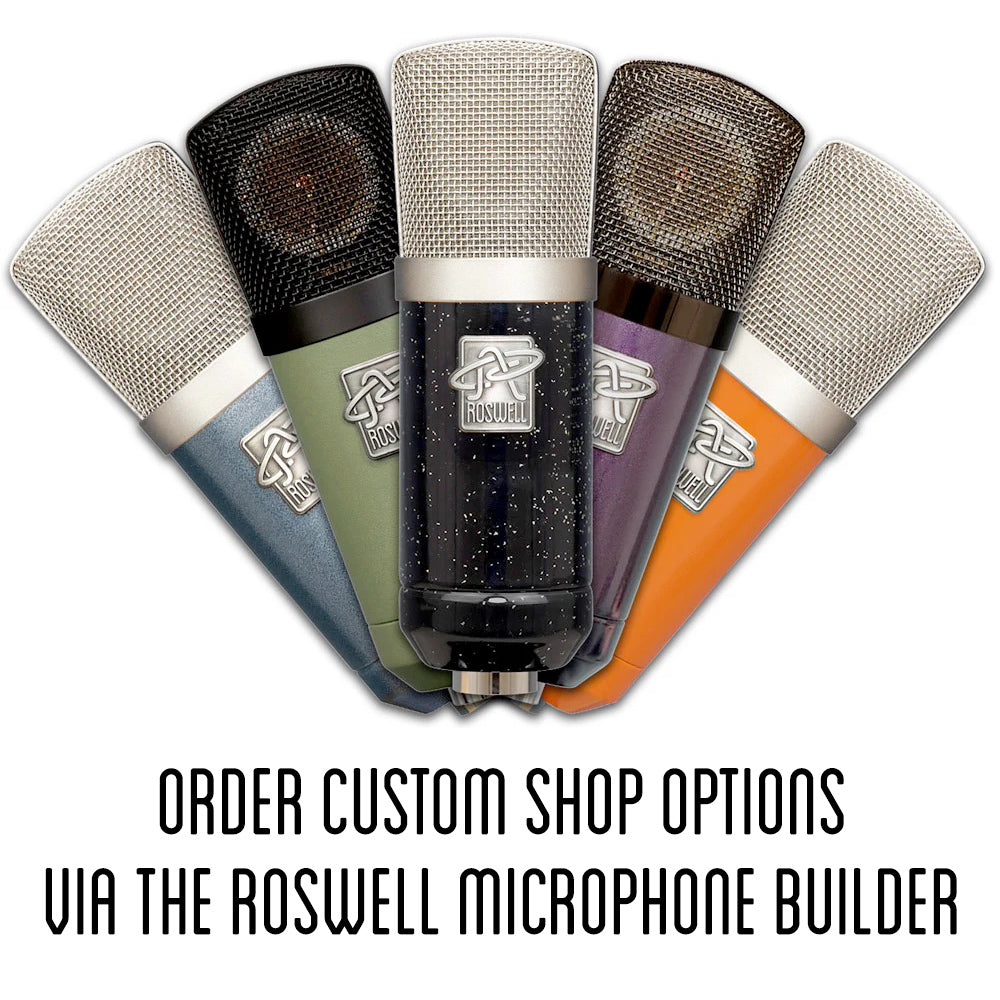
Click here to customize / personalize your Cab Mic via the Roswell Mic Builder.
Included Accessories
The Cab Mic ships with a heavy duty swivel mount and a mic sock.
In our testing, shockmounts do not seem necessary for recording guitar cab; the cab is louder than (and causing more vibration than) foot or vehicle traffic, or whatever other ambient vibrations you would normally want to isolate.
If you prefer to buy the Cab Mic with a flight case and shockmount, you can order that configuration via the Custom Shop.
How To Use The Cab Mic
 Most guitarists will tell you to never aim a microphone at the center of the dust cap. It's true that that position is too bright and too harsh for common dynamic mics. But as Steve Albini pointed out many years ago, the center of the speaker is the location with the least smearing, the least filtering, the least distortion, the most clarity, and the most articulation. That's where he usually miked a cab. It's impossible to argue with his results (e.g. Nirvana).
The trick is to use a microphone that works well in that location. Albini seemed to prefer vintage RCA ribbon mics. Those sound great if you have a $4000 budget. The Roswell Cab mic works beautifully in the same position, at a slightly lower cost.
Start with the mic's grille centered on the dust cap of the speaker. Stand the mic with six inches of space between the mic grille and the speaker cloth. Crank up the amp's master volume to whatever that amp's sweet spot is; the mic can take whatever level you give it, and it won't overload the preamp.
To increase bass content, move the mic closer. To decrease bass content, move the mic back. The Cab Mic has good proximity effect -- more linear and more predictable than a ribbon mic (read that as "less likely to get muddy").
Features
- Custom large-diaphragm capsule, proprietary tuning
- High-headroom, low-distortion circuit design
- Hand-picked, audiophile-grade circuit components
- Heavy, solid steel body
Benefits
- Unique voicing makes it easy to capture the tone of your amp.
- The mic's gain staging accommodates 100W tube amps, without clipping your preamp or converters.
- Solid, high-quality construction ensures real-world durability and long service life.
Comparing the Cab Mic to Mini K microphones
All four of the "Mini K" mics (Mini K47, Mini K47x, Mini K67x, Mini K87) can be used on guitar cabs. They can work beautifully in that application. The band Little Feat used the Mini K67x on two cabs on stage for several years, then changed to the Cab Mic.
The Cab Mic has lower sensitivity, lower output, and more headroom than all of those models; therefore if your cab is loud, the Cab Mic will usually perform better than the Mini K models.
In terms of the mic's internals, the Cab Mic uses a different capsule from the rest of the mics. The Cab Mic's circuit has a similar topology to the KD, because the main applications of these two models (guitar cab and kick drum) require very high SPL capability. The Cab Mic circuit is unique in its frequency response and distortion characteristics, and employs some very nice vintage European film capacitors not found in other models. Like every other Roswell microphone, the Cab Mic is specifically voiced, tuned, and optimized to delivery extremely high performance for its intended application.
Comparing the Cab Mic to Ribbon mics
As noted previously, the Cab Mic's voicing is similar to ribbon mics, primarily in its frequency response above 1kHz. The Cab Mic's response rolls off gently above 3kHz, which prevents guitar cabs from sounding harsh.
The Cab Mic has a nominally Cardioid polar pattern, which gives it more-linear and more predictable proximity effect than any Figure-8 ribbon. (For the purists: the Cab Mic's polar pattern is slightly narrower than textbook Cardioid; this helps give the mic its punchy, articulate sound.)
The Cab Mic is not fragile in the way that ribbon mics are. A puff of air on the capsule will not break the Cab Mic.
Using the Cab Mic on other sources
The Cab Mic's primary application is to record amplified guitar cabinets. It will work beautifully on trumpet and other brass instruments, and on many percussion sources. It will work well as a drum room mic; its soft top end naturally attenuates cymbal wash, which is a desirable characteristic for drum room tracks that would be heavily compressed.
This model is not intended for use on vocals, acoustic guitars, acoustic bass, or piano. Every other Roswell microphone will deliver superior results on those sources. This model's internal gain staging is optimized for high SPL sources, e.g. guitar cab, brass, drum room.
Cab Mic FAQ
Q: Does the Cab Mic require phantom power?
Yes. The Cab Mic is a large-diaphragm condenser microphone. It requires +48V phantom power.
To learn how to engage "P48" on many different audio interfaces, see our article: How to turn on phantom power
Q: Is the Cab Mic compatible with Neural DSP hardware?
The Quad Cortex and Quad Cortex Mini both supply phantom power, and should be compatible with the Cab Mic.
The Nano Cortex does not contain a phantom power supply; using the Cab Mic with the Nano Cortex therefore requires the use of an external phantom power supply (find options on Amazon).
Q: How should the Cab Mic be positioned?
The mic includes a printed "quick start" guide that illustrates the recommended starting position: center the mic's capsule on the dust cap of the speaker. Position the mic six inches (15cm) from the grille cloth. Move the mic closer if you need more bass (unlikely) or back it off farther to reduce bass.
That position is a starting point, not a requirement. The key takeaway here is that the Cab Mic is not an SM57 and need not be (a) shoved against the grille cloth, nor (b) positioned "off cone", nor (c) angled to put the speaker off-axis.
The Cab Mic has much better bass response than most common dynamic mics; therefore it need not be and usually should not be pressed into the grille cloth. It will sound more natural if positioned as we recommend -- but of course, your ears and preferences are the final guide to mic position.
Q: Can the Cab Mic be used on loud, 100W tube amps?
Yes. We designed the mic's internal gain staging to withstand 100W amps without clipping the mic's internal circuitry and without clipping the mic preamp or audio interface.
The Cab Mic has approximately 6dB higher sensitivity than an SM57. For most preamps, start with the input gain set to the minimum level.
For preamps that insist on adding 10-20dB of gain even when the input gain control is minimized (e.g. the 1073), engage the preamp's attenuation pad.
See this video of the No Cover Charge team recording a 100W Marshall through the Cab Mic.
Q: Can the Cab Mic be used with a second or third mic on the same guitar cab?
It can, of course, but it was designed to make the use of multiple mics unnecessary. Many guitarists seem to think that the only way to get a good recorded sound is to combine multiple microphones. While it is true that multiple mics can be used to great effect, that approach has a high cost, including the risk of comb filtering and the need to EQ and mix the two or three tracks.
We recommend auditioning the Cab Mic on its own, positioned as we recommend, before deciding whether it is necessary to add more microphones to capture a sound that works for your production.
Most Cab Mic buyers report getting the best-sounding tracks they've ever captured, using one Cab Mic on its own. They also report significant time savings: no need to set up multiple mics, set input gain for multiple channels, position multiple mics for best sound and no comb filtering, EQ multiple tracks independently, mix multiple tracks to create one cohesive sound.
Q: Is it difficult to position the Cab Mic?
No. The Cab Mic was designed to be very easy to position: literally center it on the speaker, six inches back. There is no need to mark the cab's off-cone "sweet spot" with tape. There is no need for a remote-controlled robot positioning arm. There is no need to move the mic by quarter-inches to find the best position.
The Cab Mic has much fuller frequency response than any of the common dynamic mics used for this application, and it is much less fussy about position.
Tech Data
| Model: | Cab Mic |
| Acoustic Principle: | Pressure gradient transducer |
| Polar Pattern: | Cardioid |
| Capsule: | 34mm O.D. True Condenser |
| Sensitivity: | 4 mV/Pa |
| Impedance: | 112 Ohms |
| Signal-to-noise: | 83 dBA |
| Equivalent noise: | 11 dBA |
| Supply voltage: | 48±4 VDC |
| Output: | Electronically balanced |
| Physical dimensions: | 150 × 44mm; 380g (mic only) |
Couldn't load pickup availability
Cab Mic - Guitar Microphone




-
acoustic principlePressure gradient transducer
-
polar patternCardioid
-
capsule34mm large diaphragm, gold plated
-
sensitivity4 mV/Pa
-
impedance112 Ohms
-
equivalent noise11 dBA
-
supply voltage48±4 VDC
-
outputElectronically balanced
-
physical dimensions150 × 44mm; 380g (mic only)